Can You See Planets With a Small Telescope?
I’ll never forget the first time I pointed a humble 60mm refractor at Jupiter. I was expecting maybe a bright dot, perhaps slightly bigger than usual. What I got instead was a tiny disc with two dark bands stretching across it, and four little points of light lined up like celestial soldiers. I literally gasped. That moment hooked me for life, and it cost me less than a decent pair of trainers.
Can You See Planets with a Small Telescope?
Yes, absolutely. You can see planets with a small telescope, and you’ll see far more than you might think. The real question isn’t whether you can see them, but rather what you’ll discover when you do. Even a modest 60mm to 90mm telescope opens up views that would have left ancient astronomers weeping with envy.
Here’s the truth that big telescope manufacturers don’t always shout from the rooftops: aperture matters, but a small telescope in the hands of someone who knows where to point it beats a large telescope gathering dust in a cupboard every single time. Your journey into planetary observation doesn’t require a second mortgage or a degree in astrophysics.
What Makes a Telescope “Small” Anyway?
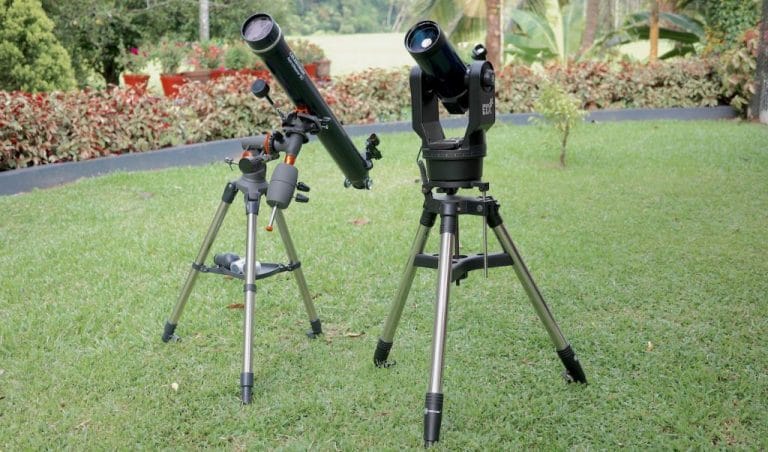
When we talk about small telescopes, we’re generally referring to instruments with an aperture (the diameter of the main lens or mirror) between 50mm and 90mm. These are your entry-level refractors and compact reflectors, the kind you might find for $100 to $500. They’re portable, affordable, and genuinely capable.
The sweet spot for beginners sits around 70mm to 90mm. This size gives you enough light-gathering power to see planetary features without requiring a forklift to transport or a manual the size of War and Peace to operate. You can set one up in your garden in under five minutes, and that convenience translates directly into more observing time.
The Magnificent Five: What You’ll Actually See
Jupiter: Your Gateway Drug to Planetary Observing
Jupiter is ridiculously rewarding through small telescopes. With even a 60mm scope at 40x magnification, you’ll spot the planet’s famous cloud bands, those dark belts running parallel to the equator. The four Galilean moons (Io, Europa, Ganymede, and Callisto) are visible as distinct points of light, and their positions change noticeably from night to night.
Here’s something most guides don’t mention: Jupiter’s moons occasionally cast tiny shadows on the planet’s face during transits. With a 90mm telescope under steady skies and at 100x magnification, you can actually see these shadows as small dark dots creeping across Jupiter’s clouds. It’s like watching a cosmic shadow puppet show.
The Great Red Spot, that famous storm larger than Earth itself, appears more as a Great Beige Oval in small scopes, but you can definitely see it as a notch or oval indentation in the southern hemisphere when it rotates into view. Patience and good atmospheric conditions help enormously.
Saturn: Worth Every Penny You Spent
If Jupiter hooks you, Saturn seals the deal. Those rings aren’t just visible in small telescopes; they’re unmistakable and genuinely breathtaking. Even a 50mm scope at 50x magnification clearly shows Saturn’s rings separated from the planet’s body.
With a 70mm to 90mm telescope, you’ll also notice the Cassini Division, that dark gap in the rings discovered in 1675. It appears as a thin dark line dividing the rings roughly two-thirds of the way out from the planet. You might also catch Titan, Saturn’s largest moon, looking like a small star near the planet.
The rings change their appearance dramatically over Saturn’s 29.5-year orbit. Sometimes they’re wide open and spectacular, other times they’re edge-on and nearly invisible. We’re currently in a period where the rings are tilting toward edge-on, which actually makes the planet look quite odd but fascinating.
Mars: Timing Is Everything
Mars plays hard to get. During much of its orbit, it appears disappointingly small even through decent telescopes. But during opposition (when Mars and Earth are closest), roughly every 26 months, Mars swells to a size where small telescopes can reveal genuine surface features.
With a 90mm scope at 100x to 150x magnification during a favourable opposition, you’ll see Mars as a tiny orange disc with darker patches representing regions like Syrtis Major. The polar ice caps appear as bright white spots at the planet’s poles. Don’t expect the dramatic views you’ve seen in books, though. Mars requires patience and practice to observe well.
Here’s the trick: Mars rotates every 24 hours and 37 minutes, so features rotate into view at nearly the same time each night, just 37 minutes later. Observe at the same time for several nights, and you’ll watch the planet spin before your eyes.
Venus: Beautiful but Frustrating
Venus blazes as the brightest planet in our sky, but it’s a bit of a one-trick pony for small telescopes. You’ll see its phases clearly (just like the Moon’s phases), which cycle as Venus orbits the Sun inside Earth’s orbit. When Venus appears as a crescent, it’s genuinely gorgeous.
The frustrating bit? Venus is shrouded in thick clouds, so you won’t see any surface features regardless of your telescope size. Those clouds reflect sunlight brilliantly, making Venus dazzlingly bright but featureless. Still, watching Venus transition from a gibbous phase to crescent is genuinely rewarding and was actually crucial evidence for Copernicus’s model of the solar system.
Mercury: The Challenge Coin
Spotting Mercury through a small telescope earns you serious bragging rights. It’s not that Mercury is faint, but it never strays far from the Sun, so you’re always observing it low on the horizon during twilight. This means you’re looking through thick, turbulent atmosphere that makes everything shimmer and blur.
With persistence and a clear horizon, you’ll see Mercury as a tiny disc showing phases like Venus. That’s about it, but honestly, just finding Mercury consistently makes you a better observer than 90% of telescope owners.
The Technical Stuff That Actually Matters
Magnification: Higher Isn’t Always Better
New telescope owners obsess over magnification numbers, and I get it. Bigger sounds better. But here’s the reality: a small telescope has practical magnification limits determined by its aperture. The useful maximum is roughly 2x per millimetre of aperture, so a 70mm telescope maxes out around 140x under perfect conditions.
Push beyond that, and you’re just magnifying blur. The image gets dimmer, fuzzier, and more susceptible to atmospheric turbulence. For planetary viewing with small telescopes, you’ll spend most of your time between 50x and 100x magnification, where images remain sharp and bright.
Here’s something experienced observers know: sometimes lower magnification shows more detail because the image is brighter and steadier. On nights when the atmosphere is acting up (what astronomers call poor “seeing”), dropping from 100x to 60x often reveals details that disappear at higher powers.
The Atmosphere: Your Invisible Enemy
Atmospheric seeing affects small telescopes more than anything else. Earth’s atmosphere acts like looking through a swimming pool, with layers of air at different temperatures constantly shifting and distorting incoming light. Planets twinkle, blur, and seem to boil at higher magnifications.
The best planetary viewing often happens in the hour or two after sunset when the ground stops radiating heat and the air settles down. Winter months generally provide steadier seeing than summer, though you’ll be freezing while you observe. Coastal areas often experience better seeing than inland locations, though local conditions vary wildly.
Accessories That Multiply Your Telescope’s Power
A good Barlow lens effectively doubles or triples your magnification options by extending the focal length of your eyepieces. A 2x Barlow turns your 25mm eyepiece into a 12.5mm, doubling the magnification. For $60 to $100, a quality Barlow lens dramatically expands what you can see. If interested, you can check out some of our Barlow Lens picks here.
Colour filters enhance planetary details by increasing contrast. An orange or red filter on Mars darkens the sky and enhances surface features. A light blue filter on Jupiter brings out the cloud bands. These screw onto eyepieces and cost $20 to $50 each, making them affordable upgrades that genuinely improve views.
A solid star diagonal or right-angle viewer makes looking at planets much more comfortable, especially when they’re high overhead. Comfort matters more than you’d think. When you’re comfortable, you observe longer and see more.
When and Where: Location Matters
Planets appear brightest and steadiest when they’re highest in the sky, well above the horizon’s turbulent air. In the Northern Hemisphere, this means observing planets when they’re due south. In the Southern Hemisphere, look north. Simple geometry, but it makes a measurable difference.
Light pollution bothers planetary observers far less than deep-sky observers. Planets are bright enough to punch through urban skyglow quite effectively. I’ve had excellent planetary views from central London balconies. You don’t need dark country skies; you just need clear skies and a bit of patience. It’s always worth keeping some light-pollution filters to hand for when you can’t fully escape it.
Let your telescope cool down to outdoor temperature before observing. Temperature differences inside the tube create air currents that destroy image quality. Give it 20 to 30 minutes outside before expecting sharp views. Many disappointing first observations happen because someone rushed from a warm house straight to the eyepiece.
Managing Your Expectations (While Staying Excited)
Planetary images from spacecraft and large observatories have spoiled us rotten. Your small telescope won’t show Hubble-quality views, and that’s fine. What you’re seeing is real-time, direct photons that left those distant worlds and travelled millions of kilometres to land on your retina. No photograph captures that connection.
Your brain needs training to see planetary details. The first time you look at Jupiter, you might just see a blob with stripes. Look again the next night. And the next. Suddenly one evening, details pop out that were invisible before. This phenomenon, called training your eye, is absolutely real and happens to everyone who sticks with observing.
Features appear and disappear based on atmospheric conditions, your eye’s adaptation, and even how tired you are. Some nights everything clicks, and you see details you’ve never noticed before. Other nights, nothing looks quite right despite clear skies. That’s planetary observation for you, full of surprises and small victories.
The Bottom Line
Can you see planets with a small telescope? Not only can you see them, but you can also observe genuine features, track changes over days and weeks, and experience the same sense of wonder that captured humanity’s imagination for centuries. Your 70mm refractor provides views that would have made Galileo’s jaw drop in 1610.
The planets are up there right now, waiting. They’re not going anywhere, and they’re far more accessible than you might think. That small telescope gathering dust in your spare room or calling to you from a shop window? It’s genuinely capable of showing you worlds beyond Earth. You just need to point it upward and look.
Start with Jupiter or Saturn depending on what’s visible in your evening sky. Give yourself time to learn your telescope’s quirks and develop your observing eye. The universe rewards patience and curiosity in equal measure, and small telescopes provide exactly the right entry point for both.