Who Invented The Telescope?
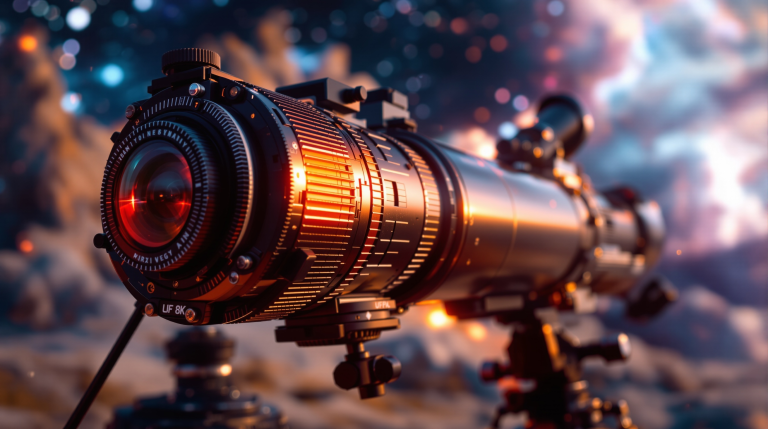
Picture this: you’re standing in early 17th century Holland, and someone hands you what looks like a decorated tube with glass at both ends. You peer through it and suddenly, the church steeple three kilometres away looks close enough to touch. Your jaw drops. That moment of wonder is exactly what sparked one of history’s most fascinating (and surprisingly contentious) invention stories.
Who Invented the Telescope?
The truth is, Hans Lipperhey, a Dutch eyeglass maker, is generally credited with inventing the telescope in 1608. But here’s where it gets interesting: at least two other people claimed they invented it first, and the patent office drama that followed reads like something from a modern startup rivalry.
The story isn’t as simple as “one genius had a eureka moment.” It’s messier, more human, and honestly more fascinating than that neat narrative we often get in textbooks.
The Dutch Eyeglass Makers and Their Competing Claims
In September 1608, Hans Lipperhey walked into the States General of the Netherlands (think of it as their parliament) and applied for a patent on a device that could magnify distant objects. He called it a kijker, which simply means “looker” in Dutch. The device used a convex objective lens and a concave eyepiece to magnify objects about three times their normal size.
But here’s the kicker: within weeks, two other Dutch spectacle makers, Jacob Metius and Zacharias Janssen, came forward claiming they’d invented it first. Imagine the bureaucratic headache that created in 1608.
The patent committee found themselves in a bind. Multiple people were demonstrating similar devices, and word was spreading that the invention was becoming so well known that granting a patent would be pointless. They ultimately denied Lipperhey’s patent application, though they did pay him handsomely to make several binocular versions for military use. Nothing says “we believe you but…” quite like a consolation payment, right?
Why Lipperhey Gets the Credit
So why do we remember Lipperhey’s name and not the others? Documentation matters. Lipperhey’s patent application is the earliest written record we have of someone formally describing a refracting telescope. While Metius and Janssen may have had legitimate claims, Lipperhey was simply first to the filing office with proper paperwork.
There’s also a charming legend (probably apocryphal) that Lipperhey got the idea when he noticed children in his shop playing with lenses, holding two up in sequence and exclaiming about distant objects appearing closer. Whether that’s true or not, it illustrates an important point: sometimes invention is about recognizing the significance of something others might dismiss.
What Galileo Did With Someone Else’s Invention
Galileo Galilei didn’t invent the telescope, but he absolutely revolutionized what we could do with it. When news of the Dutch invention reached Venice in 1609, Galileo immediately grasped its potential. Within 24 hours of hearing a description (not even seeing one), he’d figured out the optical principles and built his own version.
Here’s what makes Galileo remarkable: while others saw a military or nautical tool for spotting distant ships, Galileo turned it skyward. His telescope could magnify objects about 20 times, a significant improvement over Lipperhey’s original threefold magnification. That difference mattered immensely when observing celestial objects.
Between late 1609 and early 1610, Galileo made discoveries that would shake the foundations of astronomy. He observed mountains and craters on the Moon, proving it wasn’t a perfect sphere as Aristotelian philosophy claimed. He discovered four moons orbiting Jupiter, demonstrating that not everything in the heavens orbited Earth. He saw that Venus had phases like our Moon, providing evidence for the Copernican heliocentric model.
Think about that for a moment: within months of pointing this new tool at the sky, centuries of astronomical assumptions crumbled. It’s like if someone invented a better microscope today and immediately discovered a completely new form of life.
The Forgotten Englishman Who Might Have Been First
Now for a plot twist: some historians argue that Thomas Digges, an English mathematician, may have actually created a functioning telescope decades earlier, around 1570. His father, Leonard Digges, wrote about an instrument using mirrors and lenses that could make distant objects appear closer.
The evidence is sketchy and largely circumstantial, which is why you won’t find Digges in most history books as the telescope’s inventor. But it raises an intriguing question: how many inventions throughout history were created earlier than we think, only to be forgotten because someone else later did a better job of publicizing or documenting them?
Why the Invention Happened When It Did
The telescope didn’t emerge from nowhere in 1608. It required several technological precursors to fall into place, like dominoes setting each other off. High quality glass production had advanced significantly in Venice and the Netherlands by the late 16th century. Lens grinding techniques had improved dramatically thanks to the eyeglass industry, which had been serving the reading needs of Europe for over 300 years.
By the early 1600s, thousands of spectacle makers across Europe were experimenting with different lens combinations. The telescope wasn’t so much a lightning bolt of individual genius as it was an idea whose time had come. Multiple people arrived at similar solutions because they were all working with the same tools, the same knowledge base, and the same materials.
This is actually how most inventions happen. We like to imagine lone geniuses having eureka moments, but the reality is usually more collaborative and incremental. The inventor is often simply the person who refined the concept enough to make it practical, or who happened to be in the right place at the right time with the right connections.
The Military Applications Nobody Likes to Talk About
Here’s something that often gets glossed over in astronomy focused histories: the telescope was immediately recognized as a military game changer. Being able to spot enemy ships or troop movements from greater distances provided an enormous tactical advantage. The Dutch government’s interest in Lipperhey’s device was primarily military, not scientific.
Galileo himself presented his improved telescope to the Venetian Senate by emphasizing its military and commercial value for spotting ships at sea. Only after securing financial support did he have the freedom to pursue astronomical observations. Sometimes you’ve got to pitch the practical applications before you can indulge your curiosity about Jupiter’s moons.
How the Telescope Changed Everything
The telescope’s invention marks one of those rare moments when a tool fundamentally changes how humans understand their place in the universe. Before telescopes, astronomy was limited to what our naked eyes could perceive. That’s like trying to understand biology without microscopes or trying to explore the ocean floor without submarines.
Within just a few decades of 1608, astronomers had mapped the Moon’s surface, discovered sunspots, observed Saturn’s rings (though they didn’t initially understand what they were seeing), and tracked comets with unprecedented precision. Each discovery built upon the previous one, creating an accelerating cascade of knowledge.
The reflecting telescope, invented by Isaac Newton in 1668, improved upon the original refracting design by using mirrors instead of lenses. This eliminated the chromatic aberration (colour fringing) that plagued early refracting telescopes. It’s a perfect example of how inventions evolve: someone creates something revolutionary, and then others immediately start figuring out how to make it better.
So Who Really Invented It?
If you need a name for a quiz answer, go with Hans Lipperhey. He’s got the earliest verifiable documentation and the closest thing to an official recognition from his contemporary authorities. But the fuller truth acknowledges that the telescope emerged from a convergent moment in technological history when multiple capable people were experimenting with similar optical principles.
Lipperhey built it and sought recognition for it. Galileo perfected it and showed us what it could really do. Countless others whose names we’ll never know contributed techniques, insights, and incremental improvements that made it all possible.
That’s not a cop out answer; it’s actually a more accurate picture of how innovation works. Ideas rarely spring fully formed from a single mind. They’re collaborative efforts stretched across time and geography, building on foundations laid by others, often simultaneously discovered by multiple people working independently.
The next time you look through binoculars or see photos from the James Webb Space Telescope, you’re experiencing the legacy of those early 17th century Dutch lens grinders who probably had no idea they were about to change humanity’s cosmic perspective forever. They just knew they’d made something pretty cool that made faraway things look closer. Sometimes that’s enough to start a revolution.